Two GT-Rs, the same intermittent problem
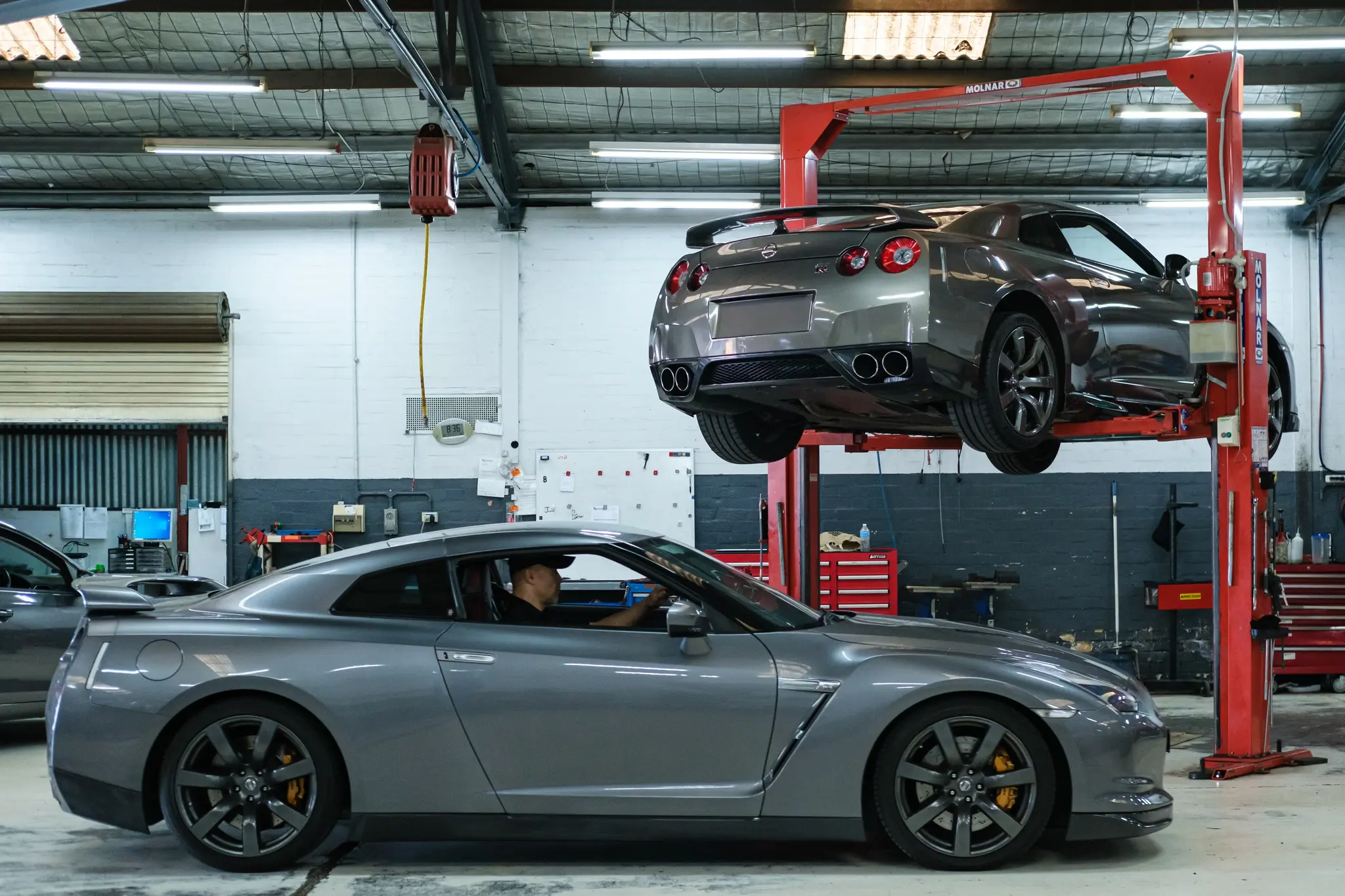
We see the same fault show up on multiple cars within a short window fairly often. In this case, two early-model R35 GT-Rs came into the workshop within days of each other, both with intermittent gear selection issues. One owner described occasional hesitation pulling away from traffic lights. The other had the drivetrain warning light flickering on under hard acceleration before clearing on the next drive cycle. Both cars were still driveable. Both owners had been living with the issue for a while, hoping it would go away.
It won’t go away. On the R35, intermittent drivetrain faults that get ignored tend to escalate into very expensive transmission failures. Both owners made the right call getting their cars in before things got worse.
Understanding the GR6 dual-clutch transmission
To understand why these faults happen, it helps to know what the GR6 actually is. The R35 GT-R uses a rear-mounted, transaxle-style dual-clutch gearbox. It has two clutch packs, one controlling odd gears and one controlling even gears, which lets it pre-select the next gear before the current shift finishes. That’s how it delivers those rapid gear changes the GT-R is known for.
The whole system runs on precise hydraulic control. Pressure sensors monitor line pressure, clutch pack pressure, and shift actuator pressure throughout the box. Solenoids control fluid flow to engage and disengage clutches, actuate gear selection forks, and manage torque transfer between clutch packs during shifts. The Transmission Control Module (TCM) reads all of these inputs in real time, making decisions in milliseconds. When every sensor reads accurately and every solenoid responds within spec, the system works well. When a sensor drifts or a solenoid develops an intermittent fault, you get anything from subtle shift hesitation to complete loss of gear engagement.
Why static fault codes aren’t enough
The difficulty with diagnosing intermittent GR6 faults is that static codes often don’t tell the full story. A pressure sensor drifting out of spec might only produce a bad reading under specific conditions, like when the transmission is at operating temperature and under load in a particular gear. A solenoid with an intermittent electrical fault might test fine with a multimeter on the bench but fail to respond quickly enough under rapid cycling during a fast upshift.
This is where the diagnostic approach matters. Rather than plugging in a scan tool, reading the stored codes, and replacing whatever part the code points to, we took a methodical approach. Both cars were instrumented with live TCM data logging and driven across multiple drive cycles under varied conditions: cold start, city traffic, highway cruise, and hard acceleration through the gears. The goal was to capture the fault as it happened in real time, not rely on a snapshot stored in the TCM’s memory after the fact.
Isolating the root cause
The logged data from both cars told a clear story. On both GT-Rs, the gearbox pressure sensors were drifting out of calibration under sustained thermal load. Readings would start within spec when cold and gradually drift as the fluid reached operating temperature. Eventually they’d reach a point where the TCM’s shift strategy couldn’t compensate for the inaccurate pressure data. That showed up as hesitant shifts and the occasional drivetrain warning.
On one of the two cars, we also found a solenoid response time issue. The solenoid was physically working, but its response time had degraded to where it couldn’t cycle fast enough for the TCM’s demands during rapid gear changes. Under gentle driving, the slower response was hidden. Under hard acceleration or fast downshifts, the delay caused a momentary loss of clutch pressure, and the TCM flagged it.
This is a well-known failure pattern on pre-2012 R35 GT-Rs. The early sensors and solenoids accumulate wear from high cycle counts and thermal stress, and their performance degrades gradually over tens of thousands of kilometres. It’s not a sudden failure. It’s a slow drift that eventually crosses the threshold of what the TCM can tolerate.
The fix and verification
The affected pressure sensors and solenoids were replaced on both cars. With the new components in, the transmission was re-adapted using the factory procedure. Re-adaptation matters on the GR6 because the TCM learns clutch engagement points, shift pressure targets, and timing calibrations based on the specific hardware in the gearbox. If you replace sensors or solenoids without re-adapting, the TCM is still running learned values from the old degraded components. The new parts won’t perform properly.
After re-adaptation, both cars were road-tested under the same conditions that previously triggered the faults. Multiple drive cycles through cold start, warm-up, city driving, highway cruise, and hard acceleration confirmed the faults had not returned. Shift quality on both cars was back to the crisp engagement the GR6 delivers when everything is within spec.
Catching it early saved both owners
The real takeaway from this job is what didn’t happen. A drifting pressure sensor left alone will eventually cause the TCM to apply wrong clutch pressures during shifts. Wrong clutch pressures lead to slip, which generates heat, which accelerates clutch wear, which leads to burnt clutch packs and a full transmission rebuild costing tens of thousands of dollars. A slow solenoid left alone can cause hard engagements that shock-load the gear train and damage synchroniser rings.
Both owners caught the issue at the sensor and solenoid stage. The repair bill for replacing these components and re-adapting the transmission is a fraction of what a full GR6 rebuild costs. If you own an early R35 and you’ve noticed hesitation in shifts, intermittent drivetrain warnings, or anything that doesn’t feel right, don’t wait. The GR6 is well engineered, but it needs proper diagnosis and maintenance to keep working the way it should.